“I’m going down to the cemetery ’cause the world is all wrong/Down there with the spooks, to hear ‘em sing my sorrow song.” — Cemetery Blues, Bessie Smith
LABOR DAY WEEKEND, I HAD THE GREAT PLEASURE OF VISITING NEW ORLEANS for the first time in a good 15 years. The inferno-like heat of the dwindling summer days, coupled with an oppressive humidity level that I thought only existed in the most remote rain forests, made being a pedestrian in the Crescent City quite an experience.
Sporadic thunderstorms rolled in and out, trapping tourists in shops, flooding sidewalks, and leaving steaming pavement as its calling card. But as someone who has been deprived of any real “weather events” for over a decade (Los Angeles has two seasons: warm and rainy and warm and sunny) I was not disappointed — it all just added to the excitement of being in the Big Easy once again.
I had always seen intriguing photographs of old cemeteries in New Orleans, and had heard they were all buried above ground there due to the low water table and frequent flooding. So when I started planning this trip, I knew this was something I wanted to see for myself.
My online research led me to St. Louis Cemetery No. 1, within walking distance of the French Quarter and the Mississippi River and alongside the Iberville Housing Projects, formerly Storyville, the jazz and red light district which thrived there some 100 years ago. What more could I want? It was on.
The high water table and below-sea level altitude, with a dash of French and Spanish influence and folklore thrown in for good measure, helped pave the way for these above-ground final resting places in New Orleans, and many are still buried there this way. New Orleanians refer to their graveyards as Cities of the Dead, which they indeed are with their jagged, crumbling brick buildings along the skyline.
Founded in 1789 as the city’s main burial ground, St. Louis No. 1 has above-ground tombs and Spanish-style wall vaults. There are numerous tours going here daily, but I decided to go on my own. The fact that I was on foot didn’t stop me from visiting, but in hindsight perhaps it should have. While just a hop, skip and a jump from touristy Bourbon Street, the area changes pretty quickly, and it is probably safer to go with a group.
I approach the entrance to the cemetery. A large crumbling plaster wall surrounds it, blocking my view of what lies inside. I stepped beneath the iron cross awning and into the boneyard. Before I could get my bearings, a man quickly materialized from the heavy, humid air.
“Why hello there. The name’s Bugsy. Care for a tour? Just eight dollars.” Well, OK, I thought. Why not? Plus, he said he worked for the cemetery. I’m sure the tour would be bona fide. (It wasn’t until after I returned to L.A. that I read on the cemetery’s website that tourists should not accept tours from people claiming to be cemetery employees.)
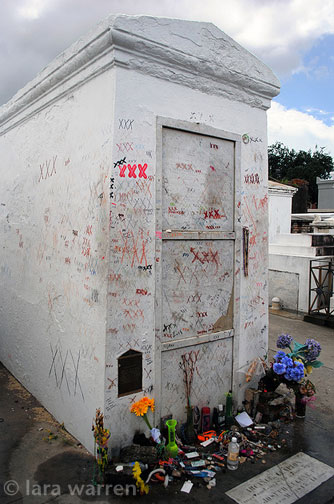
- Marie Laveau’s tomb…or is it?
But I didn’t know any of this then, and honestly I’m glad I didn’t, because otherwise I would have missed out on the best tour of my life. Bugsy was Creole, he said, standing ankle-deep in rainwater and wearing a topless straw hat and sunglasses. I was sold.
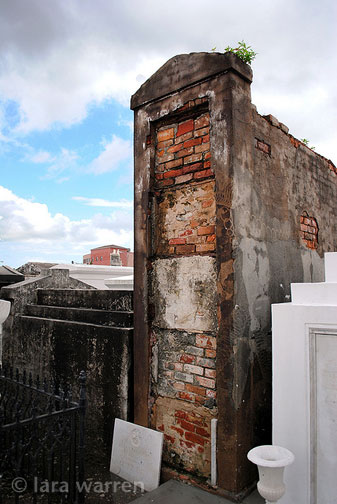
We began at the Spanish-influenced wall vaults, which frankly, looked like brick pizza ovens to me. (Or was I just hungry?) Bugsy described it to us like so:
“Imagine that you left a chicken in your oven back home. The oven is turned off of course, but if you wait a year and a day, and open that there oven back up, your chicken will have become just bones and juice. And that is what happens to the bodies in these here vaults. After a coffin is put in there, the vault cannot be opened for a year and a day. They have to wait for the body to break down first, so that they can remove it from the coffin, put it in a little box in the back, and put the next person in.” (Thanks for the gory details, Bugsy.)
Bugsy ran his finger over the names engraved in the marble plaques over the vaults, and sure enough, there were members of the same family in the same little brick pizza oven, usually with death dates a year or so apart. That’s a lot of bones and juice for one small space.
I feel a little faint at this point. Was it the 90 degree, 99 percent humidity afternoon? The jet lag from just getting into town the night before? That fried alligator po-boy for lunch?
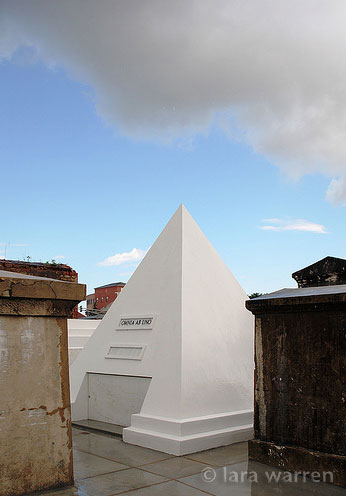
- This really is Nick Cage’s tomb
I quickly composed myself and next up was the main attraction, or at least the most notorious one: the tomb of Voodoo queen Marie Laveau. Top destination for the city’s numerous cemetery and voodoo tours. Marie was a voodoo priestess, or maybe just gossipy hairdresser. Whatever she was, she has remained a legend for centuries, and tourists visit her grave by the bus loads.
But her visitors aren’t just there to showing respect. Most of them want something. They want some of Marie’s magic.
Folklore dictates that you approach her grave, knock three times with a brick, scratch three red X’s onto the tomb, and make a wish. After Marie makes this wish come true, you return to the grave with an offering. Sadly what might have at one point been an interesting tradition has turned into a sort of base-level practice that includes leaving mixed drinks and writing graffiti in lipstick on the tomb. I don’t really think Marie would be into that. Bugsy did not approve, either, and gave us a quick primer on hoodoo and voodoo, and how people today have no respect.
Bugsy had done this very ritual, he said, when he was a young man many moons ago. “I asked to be rich,” he said. “I haven’t gotten there yet … but I’m rich in life,” he said flashing a wide, gap-toothed grin. I suppose Marie works in mysterious ways.
Did you know that actor Nicolas Cage has a tomb in St. Louis No. 1? Yeah, neither did I. Hey wait a minute—is Nicolas Cage even dead? Well, no, he’s not, and yes, he recently had a tomb built there. Assuming he won’t be using it until after death. And it’s not just any burial chamber, either. It’s a Vegas-style monstrosity: a towering white pyramid standing in stark contrast to the crumbling, centuries-old brick structures. Bugsy told us that in order to be placed in St. Louis No. 1—and apparently people still are being laid to rest there—one must have some sort of familial tie, so he assumed that is how Cage was able to get in. Creepy.
We wandered through pathways of the labyrinth-like cemetery, past a memorial for the Orleans Battalion of Artillery, who fought in the Battle of New Orleans (Bugsy said there were brass buttons still inside from their uniforms), tombs which had to be sealed forever due to a Yellow Fever outbreak, and the final resting places of many of New Orleans’ most famous residents.
After the Cage tomb, Bugsy regaled us with a ghost story about a guy from that very neighborhood who went on a date with a girl who—spoiler alert!—turned out to be a ghost. He then busted out into an impromptu blues song about bein’ done wrong and not goin’ down to the cemetery no more. A little lagniappe for us. I loved it. The “official” tour groups walking by gave us the side-eye, trying to ignore us. He continued to sing.
The wind began to pick up. The sky darkened as another thunderstorm neared. Our tour was complete. Bugsy thanked us for our money.
“It keeps me out of three houses,” he explained. “The Poor House, the Big House … and out of your house when you’re not home!”
Bugsy laughed, bid us adieu, and disappeared among the crumbling tombs.