BY LARA WARREN
IT ALL BEGAN WITH A SINGLE VISION.
Eighty years ago, Edward “Tink” Adams had a revolutionary idea for a school that would teach real-world skills to artists and designers. Even more radical: classes would be taught by working professionals, at the top of their respective fields.
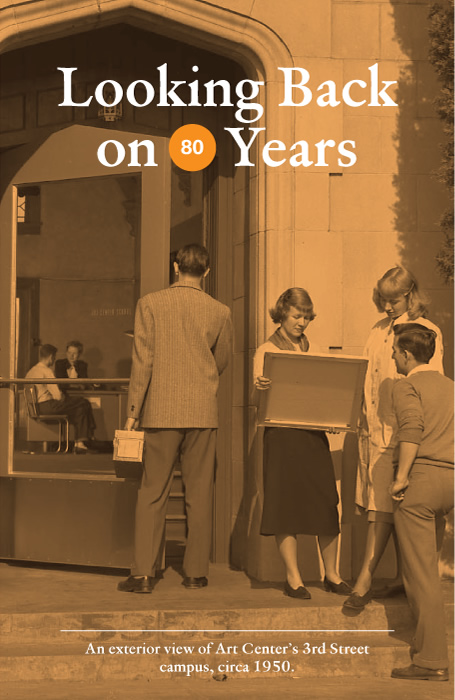
In 1930, the Art Center School opened its doors at West Seventh Street in Los Angeles with just 12 instructors and eight students. Adams, a former advertising executive from Chicago, served as director. Since then, Art Center has changed its name, moved twice (to Third Street in 1947 and to Pasadena in 1976), maintained a satellite campus in Switzerland for 10 years and opened a second campus in downtown Pasadena in 2004. Today, the College boasts a student body of 1,500 and nearly 600 full- and part-time faculty members.
Over the decades, Art Center has been home to world-renown faculty including automotive designer Strother MacMinn TRAN ’35, illustrator Phil Hays ILLU ’55, lettering and logo designer Doyald Young ADVT ’55 and illustrator Barron Storey ILLU ’61.
As we celebrate our 80th anniversary, who better to ask about Art Center’s history than our faculty—in particular those who were students here before becoming instructors? What are their favorite memories of the College?
“I’ve had a relationship with the College since 1947. That’s a long time,” says renowned graphic designer and faculty member Lou Danizger ADVT ’48, who has taught Graphic Design at the College for 50 years. “I know everybody, and believe me, I’ve seen it all.”
Danziger discovered Art Center by accident. It was 1947, and he had just moved to the West Coast from New York. After passing a building on Seventh Street near MacArthur Park, Danziger, already an advertising professional at the time, noticed a gallery and stepped inside.
“I was just blown away by the quality of the student work—it was so much better than what I was seeing out in the professional world,” he remembers. “It was staggering. I decided right then and there that I would take advantage of the GI Bill and attend Art Center.”
Drawing instructor Lorrie Madden came to the College as a student in the early 1960s. “I started out in Advertising, but soon realized that I felt painting had more of a philosophical side, which is what I was looking for.” After three terms at Art Center, she left to study privately with Lorser Feitelson, one of the most influential painters in mid-20th century L.A. and beloved Art Center instructor. While Madden did not complete her studies at Art Center (she later earned a degree from Immaculate Heart), she never truly left the College. “In 1975 I began teaching drawing at Art Center and 35 years later, I still love teaching here.”
Illustrator and former instructor Joel Nakamura ILLU ’82 first learned of Art Center from his late uncle, alumnus Lawrence Shinoda TRAN ’54. “I enjoyed drawing record covers as a teen; I had them strewn all over my room,” Nakamura remembers. “One day my uncle came in and asked, ‘You know that there are people who draw album covers for a living, right? They’re called illustrators.’ A light bulb went off in my head.” Nakamura realized that he could make a living doing what he loved, and like his uncle, he would go to Art Center to do it. “No other school was even a consideration,” he says.
When faculty member and alumnus Ron Hill TRAN ’55 was in high school, he entered the Fisher Body Craftsman’s Guild competition, a national auto design competition sponsored by General Motors. Hill, who would go on to head the College’s Industrial Design and Transportation Design departments from 1985 to 2000, won a scholarship to Art Center. “After graduating from high school on a Friday, I started my studies at Art Center the following Monday—something I’d never recommend anyone to try,” Hill says with a laugh.
As one might expect, some of the biggest influences on these alumni faculty members have been the instructors they had as students at the College.
“Some of my teachers—Phil Hayes, David Hundley, Gene Edwards—were pretty eccentric,” remembers Nakamura. “The things they would say in the classroom would probably not be acceptable today. But we loved to hear their outrageous comments during critiques. That is, until you were on the receiving end—then it wasn’t so funny. You made sure that your work was good enough to keep you off of that end.”
Design fundamentals and typography instructor Adele Bass GRPH ’81 MFA ’01 describes the faculty she had as an undergraduate were quite very strict and demanding. “You had to be on time or you were locked out of the classroom,” she remembers. “Your homework had to be up on the wall by 9 am, well-drawn, hung straight. Occasionally, an instructor would tear work down if he or she felt it wasn’t up to standard.”
Bass remembers that students were never allowed to eat and drink in the classroom. “Today my students bring in entire meals,” she laughs.
Graphic Design instructor Paul Hauge GRPH ’59 credits many faculty members with helping to shape him as a designer. “Doyald Young and Anne Mort taught me how to see,” he says, “and Lou Danziger taught me how to think.” Painting instructor John Altoon had a huge impact on Hauge. “John was so inspirational—he’d push you and bend you out of shape. He totally changed your way of looking at things.”
What motivates one to teach? At a place like Art Center, instructors already have attained success in their chosen fields. So how do they end up at—and in the case of alumni, return to—Art Center?
Madden says that the relationships she forms with her students have been her primary motivation for teaching all these years.
“The most rewarding thing about teaching is watching your students grow both as people and as artists,” she says. “I enjoy sharing with them and watching as they develop.”
Some, like Bass, did not intend to become teachers.
“You hear that some people are born to teach,” she says. “But I believe teaching is something that you grow into.” An aspiring architect, in her 20s Bass took a summer course at Harvard’s architecture school, where she was given an career aptitude test. “I really wanted to score high on this test—I wanted it to say I should be an architect,” she remembers. “But the test said my number one career calling was ‘art teacher.’ I was mortified.”
After showing her drawings to the architect teaching the course, they convinced Bass that she belonged in design school instead. Wanting to go “somewhere warm,” she left Boston for Pasadena just days before the great blizzard of 1978. After graduating from Art Center and starting a freelance design business, Bass began teaching UCLA extension courses, and eventually made her way back to Art Center, becoming a professor and earning an MFA in Graduate Media Design (while teaching full-time) from the College in 2001. “Teaching at Art Center was different for me,” she says. “It was my alma mater, and I felt a responsibility to maintain the high standards that were presented to me as a student. I’ve tried hard to do that.”
Hauge is another alumnus instructor who did not intend to return to Art Center after graduation. He began teaching in 1972 after contacting President Kubly about the caliber of work he saw coming from the College. “I offered to teach here in order to help them get back on track—I can’t believe I was pompous enough to offer that,” Hauge laughs. “But it worked!”
He taught Graphic Design at Art Center until 1989, when he left Los Angeles for Santa Fe. After returning to SoCal in 2003, he resumed teaching at the College. “Teaching is a two-way street,” he says. “Students learn from me, but I most definitely learn from them as well. Discovering that duet has been so enriching.”
Danziger thinks many students would be amazed at the ways in which he and his fellow classmates worked on assignments. “We had to render everything by hand, with pencils, chalks, brushes and pens,” he says. “We couldn’t set type on the page and try it different ways like students can today with computers. We had to take a brush and letter that stuff. It took longer, and required a high level of skill and dedication.”
In the fields of typography and design, the cutting-edge tools during Bass’ student days were markers. “Those that could perfect their marker skills were sure to get a job,” she says.
Hill believes that while the tools students use have changed, their method of working has not. “Students communicate visually and verbally using different tools than we had—we had the pencil, they have the computer,” he says. “Yet the basic premise of creating new visual experiences and environments hasn’t—and will never—change.”
In a way, the old adage that the more things change, the more they stay the same rings particularly true for Art Center.
“What has changed the most, besides demographics, are the cycles we’ve gone through,” says Madden. “The trends in art, in particular illustration and painting, are cyclical. Things continuously go in and out of fashion. For example, pop culture is such a part of fine arts today. All the movements seem merged together; yet they seemed quite separate when I was a student.”
One thing that everyone agrees will never change is the high caliber of Art Center students—they remain the world’s best.
“Walking into the student gallery 50 years ago was not unlike walking into the gallery today,” says Hill. “Today’s students are really forward-thinking. It’s always refreshing to see how incredible our students are and continue to be.”
Hill believes that the future success of students will depend on providing them with the broadest educational experience possible.
“Let them thrash out and solve problems,” he says. “That’s what design is all about—solving problems and thinking the unthinkable. And that’s what Art Center students do best.”
DOT magazine, December 2010